
Treatment guide · Compare
Huh-pa-go-ri (허파고리): moving waist fat to the hips, and how it differs from a BBL
Huh-pa-go-ri (허파고리) is a Korean trend name for a body-contouring combination: liposuction slims the waist and flanks, and some of that fat is injected into the upper hips and the hollows beside them (hip dips), so the line from waist to hip curves more smoothly. It is not a Brazilian butt lift, and the difference matters for safety. This guide explains the operation, what to expect, and the other options clinics may offer.
Facts checked:
What it is
Two operations are done in one session. First, liposuction removes fat from the waist and flanks through a few small incisions. Then part of that fat is purified and injected into the hips, where a hollow at the side of the hip (doctors call it a trochanteric depression) makes the outline dip. UK surgeons describe exactly this concern, the 'hip-dip', as a reason for grafting fat to the area. The waist gets narrower and the hips a little fuller, which changes the waist-to-hip ratio more than either step alone.
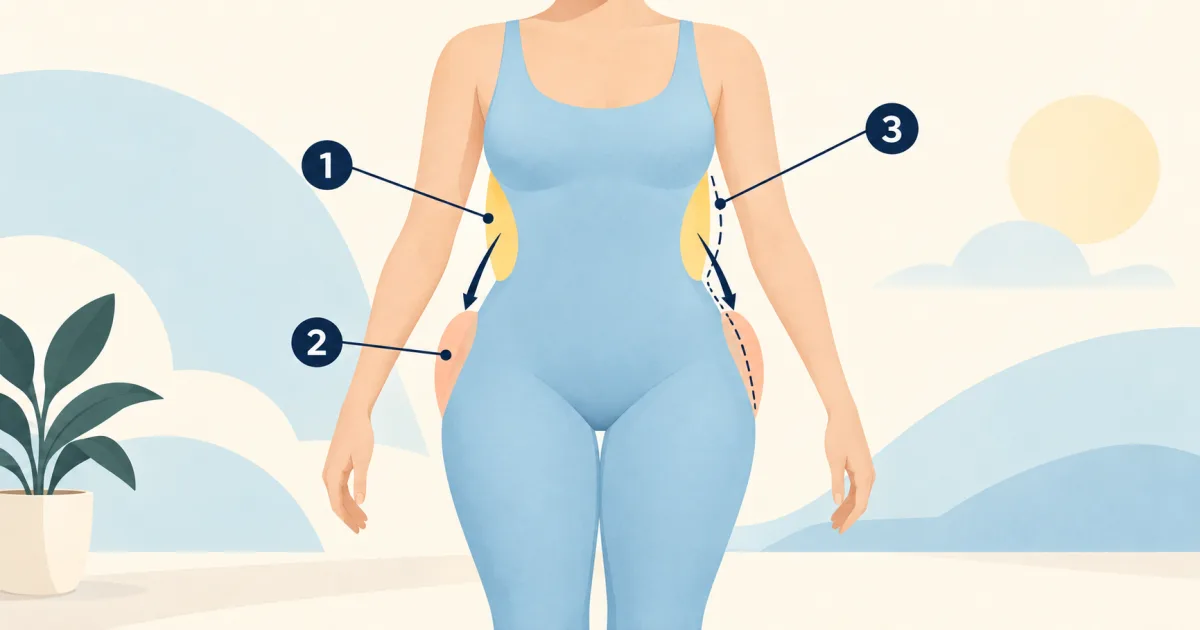
- Fat taken. Liposuction from the waist and flanks, sometimes the abdomen or back.
- Fat placed. Purified fat injected under the skin of the upper hips and the hip dips.
- Before. The dashed line is the earlier outline; the change is a gentler curve, not a new body shape.
How it is done
- Harvest. The surgeon fills the waist and flank fat with a numbing, blood-vessel-tightening fluid and removes fat gently with a thin cannula, so the fat cells survive.
- Purification. The fat is separated from fluid and blood by letting it settle, filtering it or spinning it in a centrifuge. Each method is in use; none is proven best.
- Injection. Through small openings at the hip, the fat is laid down in many thin threads in the layer under the skin, never into the muscle. Putting in more fat than the space can hold lowers how much survives, so a surgeon may plan two smaller sessions instead of one large one.
How much fat stays, and why a touch-up happens
Some of the transferred fat does not pick up a blood supply and is reabsorbed. US plastic surgeons quote survival of roughly 50–90%, depending on technique and aftercare, with about 60% a common average for the body. In a study of Asian women who had fat grafted under the skin of the buttocks, about 78% remained at three months and 65% at six. Most of the loss happens in the first three months; the shape then refines up to about six months.
That is why clinics sometimes overfill a little and why a second, smaller session is occasionally suggested to even out the sides or add volume. The fat that survives behaves like the rest of your body fat, so it grows or shrinks with your weight.
How much fat is moved depends on how much you have to spare and how much the skin at the hip can hold. No society guidance or study gives a typical volume for hip dips, so be cautious of any fixed number; for comparison, buttock grafting usually uses a few hundred millilitres per side.
Who it suits
- Adults at a stable weight with enough fat at the waist or flanks to move.
- Good skin elasticity: liposuction does not tighten loose skin, so a loose lower abdomen may need a tummy tuck instead.
- Realistic aims: the hip-dip shape comes partly from the pelvic bone, so fat softens the hollow rather than erasing it.
- Not a weight-loss operation, and very slim people may not have enough fat to spare. Smokers are asked to stop at least 4 weeks before and after, because smoking lowers fat survival and slows healing.
Recovery
- First days. The waist is sore and bruised like any liposuction; the hips feel tight. Walk gently from the first day.
- Weeks 1–2. Bruising usually fades in 7–10 days and most swelling settles in about 2–3 weeks. UK surgeons advise keeping pressure off the grafted area for the first 2 weeks: sleep on your back rather than your side, and avoid tight belts or seats that press on the hips.
- Compression. Wear the garment over the liposuction areas as instructed, usually 4–6 weeks. There is no agreed rule for how tight or how long a garment should be over the grafted hips, so follow your surgeon.
- Work and exercise. A desk job is usually possible after about 7–14 days. No strenuous exercise for 4–6 weeks.
- Results. The new curve is visible once swelling goes down, and settles over 3–6 months as some fat is reabsorbed.
Plan about 10 days in Seoul. The NHS advises not flying for at least 5–7 days after liposuction, and for a flight of four hours or more UK surgeons suggest staying 1–2 weeks after an operation of this size; your surgeon should see you before you travel. If you add more areas, plan longer, and check the entry rules and visas for Indonesian travellers.
How it differs from a Brazilian butt lift
BBL earned a bad name because fat injected deep into the buttock muscle can enter the large gluteal veins and travel to the lungs. Plastic surgery societies in the US and UK now say fat must be placed only under the skin, never into the muscle, ideally checking the cannula's position with ultrasound. As deep injection became rare, the estimated death rate fell from about 1 in 3,500 to about 1 in 15,000, similar to a tummy tuck. UK surgeons identify the inner part of the buttock, near the gluteal vessels, as the highest-risk zone; the approach to the side of the hip did not involve those vessels.
| Huh-pa-go-ri | Brazilian butt lift (BBL) | |
|---|---|---|
| Aim | Narrower waist, smoother hip line | Larger, rounder buttocks |
| Where the fat goes | Upper hips and hip dips | Buttocks, often with the hips |
| Safe layer | Under the skin only | Under the skin only, never into the gluteal muscle |
| Main serious risk | Usual liposuction and grafting risks | Fat entering large veins in the buttock muscle (fat embolism) |
If you only want a slimmer waist
- Local-anaesthesia mini liposuction (known in Korea as LAMS). A small-volume liposuction done awake with a very thin cannula; the name LAMS comes from one Korean clinic chain, and the published studies on it come from that chain's own doctors. Downtime is a few days, but less fat comes out per session, so a larger area may need several sessions. Clinics often pair it with a fat-dissolving injection: note that in the US the only approved fat-dissolving injection is for fat under the chin, and in September 2026 the FDA warned about serious reactions after use elsewhere on the body.
- Standard liposuction. Under sedation or general anaesthesia, it removes more fat in one operation. Removing 5 litres or more counts as large-volume liposuction and needs overnight monitoring.
- Tummy tuck. Neither kind of liposuction tightens loose skin or reaches the fat deep inside the belly. When the skin itself hangs, a tummy tuck removes it; see our mini, full and extended comparison.
Other ways to fill the hip dips
- Hip filler. Some clinics inject large volumes of filler into the hips. It needs no liposuction but is temporary, and the US FDA has not approved any filler for body contouring and recommends against using injectable fillers to enhance the body.
- Hip implants. A few surgeons place silicone implants at the side of the hip. This is a separate, uncommon operation with implant risks, and we found no society guidance on it.
Risks and warning signs
- Lumps: some grafted fat can harden (fat necrosis) or form small oil cysts; most are harmless but may need checking.
- Uneven result: one side may keep more fat than the other, or the liposuction areas may look uneven, which is the usual reason for a touch-up.
- Infection, fluid collection and blood clots, as after any liposuction.
- Fat embolism: rare, and linked mainly to deep injection into the buttock muscle, which is why the layer matters.
Considering one of these? Tell us your dates and we will plan the clinic visits around them.
Sources
- Gluteal fat grafting safety review and recommendations (30 September 2022)
- Six of the most common areas that plastic surgeons do fat transfers
- Six things you need to know about recovering from a Brazilian butt lift
- Wang et al., Ultrasound-assisted subcutaneous gluteal fat grafting in Asian women (JPRAS 2024;94:12–19)
- Cansancao et al., Subcutaneous-only gluteal fat grafting (Plast Reconstr Surg 2019;143:447–51)
- Gluteal fat grafting safety advisory (June 2019)
- Joint statement on gluteal fat grafting (18 August 2022)
- Rios and Gupta, Improvement in BBL safety (Aesthet Surg J 2020;40:864–70)
- Liposuction aftercare and recovery
- Butt lift aftercare and recovery
- Dermal fillers (soft tissue fillers)
- FDA approves additional information in labeling for Kybella (deoxycholic acid) injection warning of adverse reactions associated with unapproved use (2026-09-15)
- Practice advisory on liposuction (Iverson and Lynch, Plast Reconstr Surg 2004;113:1478–90)
- Ten common misconceptions about liposuction
- Paik et al., Half-saline tumescent fluid in LAMS (Sci Rep 2025;15:44287)
- Cosmetic surgery abroad
- Cosmetic Tourism Guidelines (September 2023)
This guide summarises published guidance so you can plan and ask better questions. It is not medical advice. Your doctor assesses you in person and makes every treatment decision, including when you are fit to fly.
All treatment guides