
Treatment guide · Compare
Mini, full or extended tummy tuck: which one, and how long to stay in Seoul
A tummy tuck (abdominoplasty) removes loose skin and some fat from the abdomen, and in the larger versions tightens the abdominal muscles. Clinics offer three sizes of the operation, and the difference is mostly about where your loose skin is. This guide explains the three, what recovery looks like week by week, and how to plan the stay in Seoul before the flight home.
Facts checked:
The three operations at a glance
Every version is done under general anaesthetic or, for some minis, sedation, and takes roughly one to five hours. Drains (thin tubes that carry away fluid) are often used. The surgeon chooses the operation after examining you, and many combine it with liposuction.
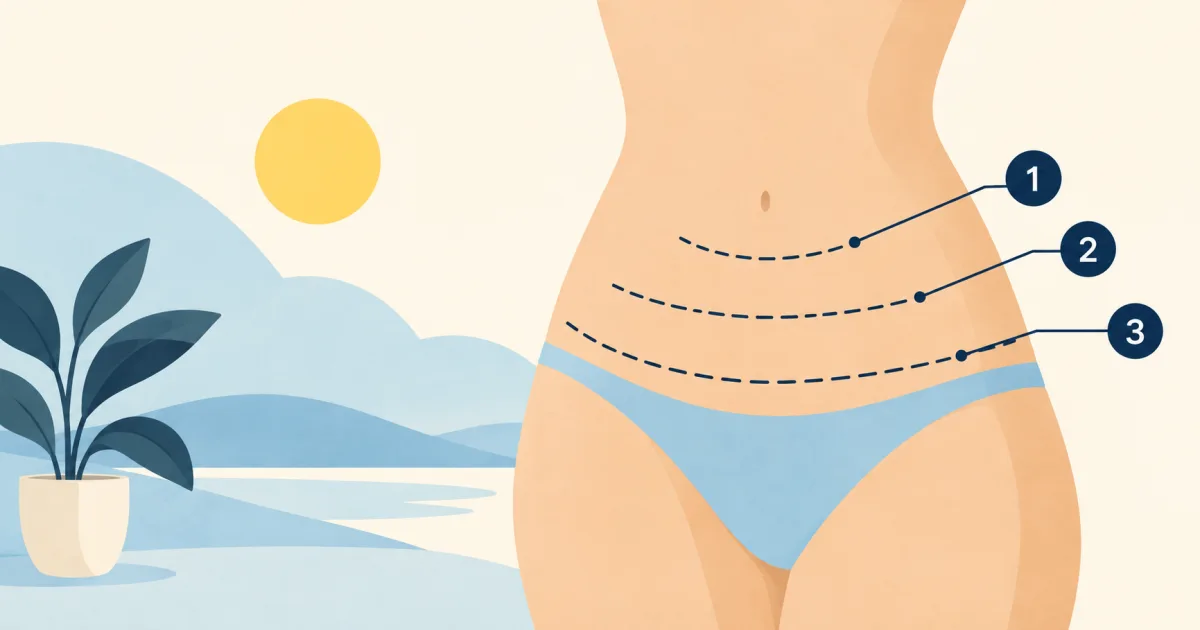
- Mini. A short incision low on the abdomen; treats loose skin below the navel only.
- Full. Runs from hip bone to hip bone; the navel gets a new opening and the muscles are usually repaired.
- Extended. The full incision carried round the sides of the waist towards the back, to take loose skin from the flanks too.
The lines are drawn one above the other so each is visible. In practice all three sit low, where underwear usually covers them.
| Mini | Full | Extended | |
|---|---|---|---|
| Loose skin | Below the navel only | Above and below the navel | Abdomen plus the flanks and lower back |
| Muscle repair (for separated muscles) | Not usually | Usually | Usually |
| Navel | Stays where it is | Given a new opening | Given a new opening |
| Scar | Short, low on the abdomen | Hip bone to hip bone | Round the sides towards the back |
| Anaesthesia | General, sometimes sedation | General | General |
| Usual stay in hospital | Often the same day | One to a few nights | A few nights |
| Plan in Seoul | About 2 weeks | About 2 weeks | About 3 weeks |
Which one suits whom
- Mini tummy tuck. A small bulge or overhang of skin between the navel and the pubic area, with firm skin above the navel. The muscles are not usually repaired, so it does not fix a stomach that bulges because the muscles have separated.
- Full tummy tuck. Loose skin above and below the navel, often after pregnancy. If the two strips of abdominal muscle have drifted apart (diastasis recti), the surgeon stitches them back together, which a mini does not usually do.
- Extended tummy tuck. Loose skin that wraps round onto the hips and the sides of the lower back, typically after major weight loss. It is a bigger full tummy tuck, not a body lift: a belt lipectomy (lower body lift) goes all the way round and treats the buttocks and thighs as well.
For all three: be at a stable weight (surgeons often ask for 6–12 months after major weight loss), have finished having children, and stop smoking at least 6 weeks before and after, since smokers heal more slowly and risk losing skin. A tummy tuck is not a way to lose weight, and it removes stretch marks only on the skin that is cut away.
Recovery, week by week
- Surgery day to day 3. You wake with a firm binder round the abdomen and possibly drains. Expect to walk slightly bent and to rest at an angle, but get up and walk short distances early, because moving lowers the risk of a blood clot. UK hospitals usually keep tummy tuck patients a few nights; some clinics discharge a mini the same day.
- Week 1. Wear the binder day and night. Drains come out once the fluid slows, which is one reason to stay near the clinic: after an extended operation they can stay in longer. A mini patient is often back to light daily activities in about a week.
- Week 2. The clinic checks the wound. After a full tummy tuck most people manage light activity at around two weeks.
- Weeks 3–6. UK guidance puts time off work at 4–6 weeks after a full tummy tuck, and many take about a month. Keep wearing the corset or binder for about 6 weeks. No lifting children or heavy bags for the first few weeks, no strenuous exercise for 4–6 weeks, and no driving for a few weeks.
- Months 3–18. Swelling can take up to three months to go down, and most people feel normal at about eight weeks. The scar is red and raised at first and fades over 12–18 months; numbness of the lower abdomen usually settles over a similar time.
Sources disagree on the hospital stay and time off: the NHS says a few nights and 4–6 weeks off work, a large US hospital says often the same day and at least a week. The plan above uses the longer figures, which suit a full or extended operation abroad.
When you can fly home
The NHS advises not flying for at least 7–10 days after a tummy tuck. For a flight of about four hours or more, the British Association of Aesthetic Plastic Surgeons (BAAPS) advises staying 1–2 weeks after an operation under three hours, and 2–4 weeks after a longer one, several areas at once, or surgery after major weight loss. Seoul to Jakarta is about seven hours.
In practice: plan about 2 weeks for a mini or full tummy tuck on its own, and about 3 weeks for an extended tummy tuck or a tummy tuck combined with liposuction. BAAPS also advises anti-embolism stockings for at least two weeks and a review by the surgeon who operated before you travel.
A three-week stay is longer than a short visit. Check which entry permit or visa fits, especially if a family member is coming to look after you: see Entry rules and visas for Indonesian travellers. Kordy can help arrange the hospital documents for a medical visa.
Risks to know
- Seroma (fluid collecting under the skin) is the most common problem, reported in about one patient in ten in a 2026 review, and more often when liposuction is added. It is usually drained with a needle at the clinic. Some surgeons use quilting stitches or preserve a deeper tissue layer to lower the risk and the time with drains.
- Wound healing problems, such as a gap in the scar or a small area of skin loss, are more likely in smokers and people with a higher BMI.
- Bleeding (haematoma), infection and blood clots were the main serious complications in a study of over 25,000 tummy tucks: 4.0% had one, against 1.4% for other cosmetic operations. Clots (DVT, and a clot travelling to the lungs, PE) are rare, but body operations and combined operations carry the highest risk, which is why a long flight soon after surgery needs care.
Combining with liposuction
Liposuction of the waist or flanks is often added to shape the sides. In the same large study, the serious complication rate was 3.1% for a tummy tuck alone and 3.8% with liposuction, rising to 10.4% when other body contouring was added as well. US plastic surgeons advise against combining a tummy tuck with large-volume liposuction (5 litres or more). Each area you add usually lengthens the operation and the stay; see Liposuction in Treatments & prices.
If your skin is still firm and the problem is fat rather than loose skin, liposuction alone, or a local-anaesthesia mini liposuction, may be enough. The comparison is in the liposuction entry's questions.
Warning signs
Before you leave
- Ask for an English summary of the operation and your medicines, and how long to keep the binder on.
- Make sure drains are out and the surgeon has seen you, then book an aisle seat, walk the cabin and drink water on the flight.
- Do not lift your bag into the overhead locker; check it in.
- Agree a phone or video follow-up with the clinic, and know where you would go for care at home in Indonesia.
Considering one of these? Tell us your dates and we will plan the clinic visits around them.
Sources
- Which tummy tuck is right for me?
- Tummy tuck procedural steps
- Tummy tuck (abdominoplasty) and procedure guide (May 2024)
- Tummy tuck
- Tummy tuck (abdominoplasty)
- The basics of the belt lipectomy
- Tummy tuck
- Tummy tuck
- What you need to know about your tummy tuck recovery
- Tummy tuck recovery
- Winocour et al., Abdominoplasty: risk factors, complication rates, and safety of combined procedures (Plast Reconstr Surg 2015;136:597e–606e)
- Winocour et al., Venous thromboembolism in the cosmetic patient (Aesthet Surg J 2017;37:337–49)
- Magalhães et al., Scarpa fascia preservation in abdominoplasty: systematic review (JPRAS 2026;118:195–208)
- Li et al., Seroma prevention in abdominoplasty: network meta-analysis (Aesthetic Plast Surg 2026;50:4717–29)
- Practice advisory on liposuction (Iverson and Lynch, Plast Reconstr Surg 2004;113:1478–90)
- Cosmetic surgery abroad
- Cosmetic Tourism Guidelines (September 2023)
- Deep vein thrombosis
This guide summarises published guidance so you can plan and ask better questions. It is not medical advice. Your doctor assesses you in person and makes every treatment decision, including when you are fit to fly.
All treatment guides