
Treatment guide · Compare
Under-eye fat repositioning: the inside and the outside approach
Korean clinics call it nunmit-jibang-jaebaechi (눈밑지방재배치): under-eye bags are not simply removed, the fat is moved down into the hollow below them so the lid-cheek line looks smooth. Surgeons reach that fat either from inside the lower lid or through a fine cut just under the lashes. Which one fits depends mostly on your skin, not on preference.
Facts checked:
Two routes to the same fat
Both are forms of lower blepharoplasty with fat repositioning (also called fat transposition). The difference is the doorway. The American Society of Plastic Surgeons describes the inside approach as a way to redistribute or remove fat in which no skin is removed; the outside approach is the one that also takes away excess lower-lid skin.
A 2025 systematic review found fat can be repositioned through either incision, though it is technically a little easier from outside. When a patient needs a skin trim as well, a surgeon may combine an inside approach with a small skin pinch, at which point the no-scar advantage is partly given up.

- Outside (transcutaneous, subciliary). A fine cut just below the lashes. Skin and muscle can also be tightened or trimmed.
- Inside (transconjunctival). A cut on the inner lining of the lower lid. No skin scar, but little or no skin is removed.
- Repositioning. The fat that bulges is moved over the bone rim into the hollow (tear trough) instead of being thrown away.
Side by side
| Inside (transconjunctival) | Outside (transcutaneous) | |
|---|---|---|
| Incision | Inner lining of the lower lid | Just below the lash line |
| Visible scar | None on the skin | Fine line under the lashes, pink for a few months, then usually hard to see |
| Skin tightening | No skin removed (a small skin pinch or laser can be added) | Skin and muscle can be tightened or trimmed |
| Typical fit | Fat bulge with good skin quality; often younger patients | Fat bulge plus loose, crepey or excess lower-lid skin |
| Stitches | Inner incision often left without stitches in published series | Removed within about a week (2–7 days) |
| Anaesthesia | Local with sedation, or general | Local with sedation, or general |
| Looking presentable | About 10–14 days | About 10–14 days |
Which one suits you
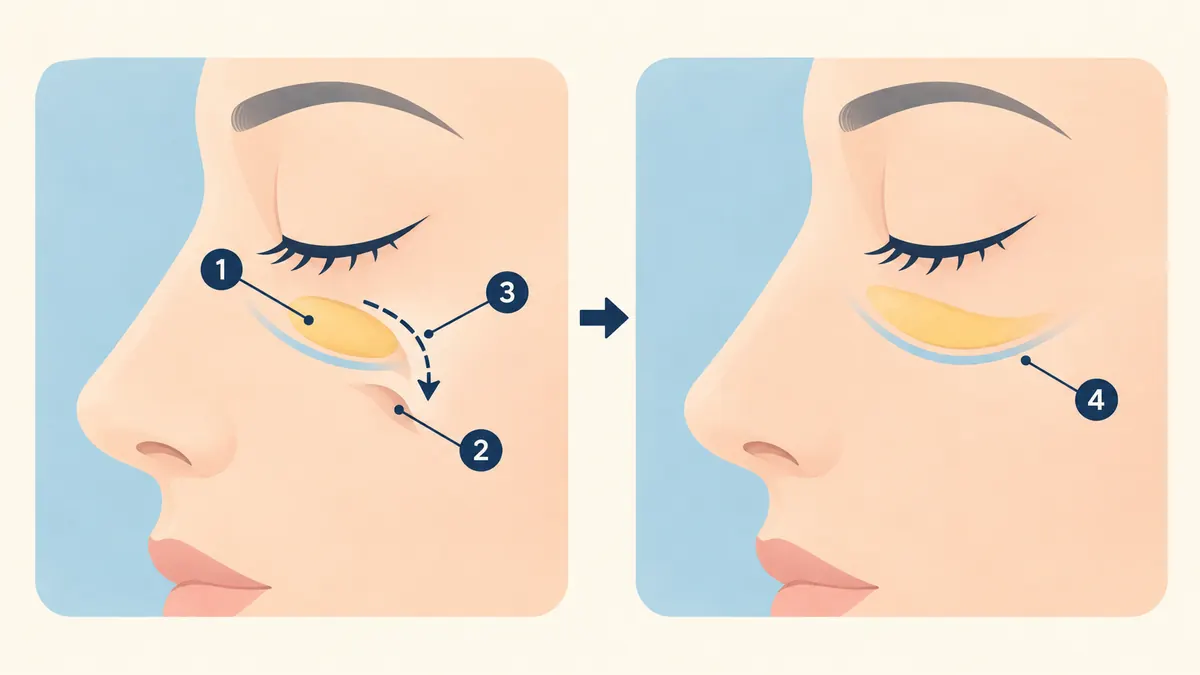
- The bulge. Fat from behind the lower lid pushes forward above the bone rim of the eye socket. This is the under-eye bag.
- The hollow. Just below it, where lid meets cheek, sits a groove (the tear trough), which makes the bag look deeper.
- Repositioning. Instead of removing all of the fat, the surgeon moves it down over the rim into the hollow.
- After. The lid-cheek line becomes one smoother curve. The change is a softening, not a new face shape.
Schematic. How much fat is moved, and whether some is removed or skin is trimmed, is the surgeon's call.
- Bulging fat, firm skin. The classic case for the inside approach. The systematic review describes it as suited to relatively young patients who do not need skin removed, and most of the studies it pooled were in Asian patients.
- Bulging fat with loose or wrinkled skin. The outside approach, because it can take away the excess skin and support the lid at the same time.
- Mostly hollowness, little bulge. There may be little fat to move. Filler or fat grafting is sometimes the better tool; ask the surgeon to explain what they see.
Age is a rough guide only. Skin quality and lid support, assessed in person, decide the approach.
Recovery, week by week
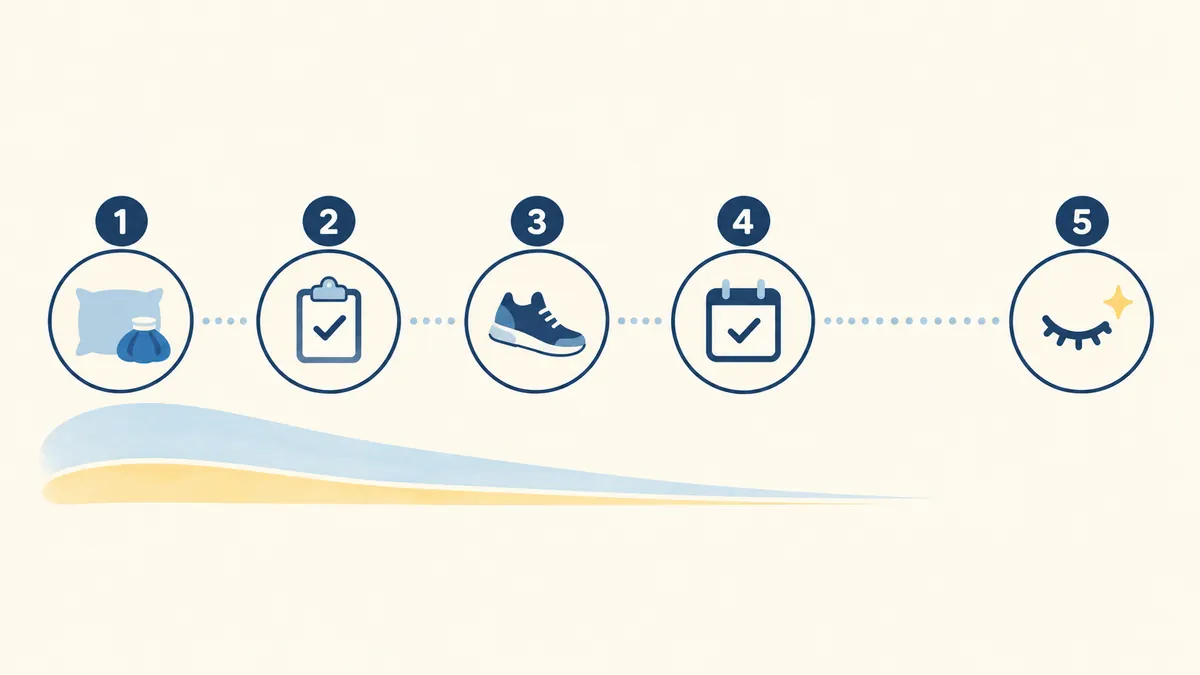
- Days 1–3. Swelling and bruising peak. Cold compresses, head raised when you sleep, no bending.
- Days 2–7. Stitches out within about a week if you had the outside approach.
- Around day 10. Most people feel ready for normal activities. No heavy lifting, straining, swimming or hard exercise for 10–14 days.
- Two weeks. Bruising has usually resolved and most people are presentable. Redness can take several weeks to fade fully.
- A few months. The final contour and any scar settle.
The bands show swelling (blue) and bruising (yellow) fading. Schematic: how fast varies from person to person.
- Days 1–3: swelling and bruising peak. Cold compresses, sleeping with your head raised and avoiding bending are standard advice.
- Days 2–7: if you had the outside approach, stitches come out within about a week. Plan to be in Seoul for this visit.
- Around day 10: most people feel ready for normal activities. Avoid heavy lifting, straining, swimming and hard exercise for 10–14 days.
- Two weeks: bruising has usually resolved; redness can take several weeks to fade fully. Most people are presentable at 10–14 days and take about two weeks off work.
- A few months: the final contour and any scar settle.
The inside approach often recovers a few days sooner: in one study of 121 patients the median recovery was 11 days with the inside approach and 15 days with the outside one, though the outside group was older and had looser skin. Recovery varies more between people than between techniques, so plan on about two weeks either way.
When you can fly home
The NHS advises not flying for 7–10 days after facial cosmetic surgery, because surgery and air travel each raise the risk of a blood clot. An oculoplastic surgeon's guidance puts lower-lid surgery at 10–14 days for a long flight. Seoul to Jakarta is about seven hours, so plan for around 10–14 days in Seoul and book a flight you can change.
If your stay will run past a short visit, check that your visa covers it: see Entry rules and visas for Indonesian travellers.
Risks worth knowing
- Lid position changes (retraction, ectropion). Historically linked more with the outside approach; a 2025 review reports symptomatic lid malposition at about 0.4% with both approaches in current series.
- Under- or over-correction and asymmetry. Many people's lower lids are uneven before surgery, so ask the surgeon to point this out at consultation. In the largest series that reported symmetry (267 patients, outside approach), about 6% still had some unevenness afterwards. In smaller series, about 2–4% of patients needed a touch-up for an uneven contour or too little change, and pooled undercorrection of the bags was around 1%.
- Dry, gritty or watery eyes and chemosis (swelling of the eye's surface membrane), usually temporary.
- Bleeding behind the eye is rare, about 1 in 2,000 in a large surgeon survey, and permanent vision loss is very rare, about 1 in 20,000 to 30,000. Most cases appear within the first hours, which is one reason clinics watch you before you leave.
Surgery or tear-trough filler?
Hyaluronic acid filler in the tear trough can soften a hollow with no downtime to speak of, but it is temporary: 6–12 months is the commonly reported duration, and one study found improvement lasting to 18 months. It does not remove bulging fat; filler is best for mild hollows with good skin and little bulge.
The area around the eyes is delicate for filler. The U.S. FDA warns that injection into a blood vessel can cause vision problems and has not approved fillers for use around the eyes. A bluish tint (Tyndall effect) or lingering puffiness can also occur. Surgery is the more durable option for a real fat bulge.
Considering one of these? Tell us your dates and we will plan the clinic visits around them.
Sources
- Eyelid Surgery: Procedure
- Eyelid Surgery: Results
- Eyelid Surgery: Safety
- Eyelid Surgery Recovery & Aftercare
- Eyelid surgery (blepharoplasty)
- Cosmetic surgery abroad
- How Soon Can You Fly After Blepharoplasty?
- How long does the swelling last after eyelid surgery?
- Transconjunctival or Transcutaneous Approach for Fat-preserving Lower Lid Blepharoplasty? A systematic review (2025)
- Exploring the Versatility of Transconjunctival Blepharoplasty (2024)
- Orbital septal fascial flap with extensive release of a long orbital fat flap (2026)
- Transconjunctival vs transcutaneous lower blepharoplasty
- A morphologic classification and surgical algorithm for lower eyelid asymmetry in primary lower blepharoplasty (2026)
- Modified lower blepharoplasty with fat repositioning via transconjunctival approach (2019)
- Orbital septal fat repositioning combined with SVF-gel fillers in lower blepharoplasty (2025)
- Persistent Conjunctival Chemosis after Lower Lid Blepharoplasty (2024)
- Incidence of postblepharoplasty orbital hemorrhage and associated visual loss (2004)
- Visual loss after blepharoplasty: incidence, management, and preventive measures (2011)
- Long-Term Effects of Tear Trough Hyaluronic Acid Filler (2025)
- Dermal Fillers (Soft Tissue Fillers)
This guide summarises published guidance so you can plan and ask better questions. It is not medical advice. Your doctor assesses you in person and makes every treatment decision, including when you are fit to fly.
All treatment guides