Treatment guide · Compare
Face lifting in Korea: surgery, threads or devices, and what each really lifts
In Seoul, "lifting" covers everything from a facelift to a 30-minute device session. They are not the same thing. Surgery moves tissue and gives one large change; threads hold tissue up for a while; devices tighten without a cut and are repeated. Here is how they differ, why Korea is moving toward the no-cut end, and which treatments mainly improve firmness rather than lift.
Facts checked:
Incisional or non-incisional: the basic split
Incisional (절개) lifting means surgery. The surgeon cuts, repositions the deeper tissue and removes or redrapes skin. It is done once and gives the largest and longest-lasting change.
Non-incisional (비절개) lifting covers everything without a scalpel incision, which in practice includes two very different groups: threads and needle-based treatments, which still pierce the skin, and energy devices such as ultrasound and radiofrequency, which do not touch the inside of the skin at all. When Korean clinics say "lifting" today, they usually mean the second group.
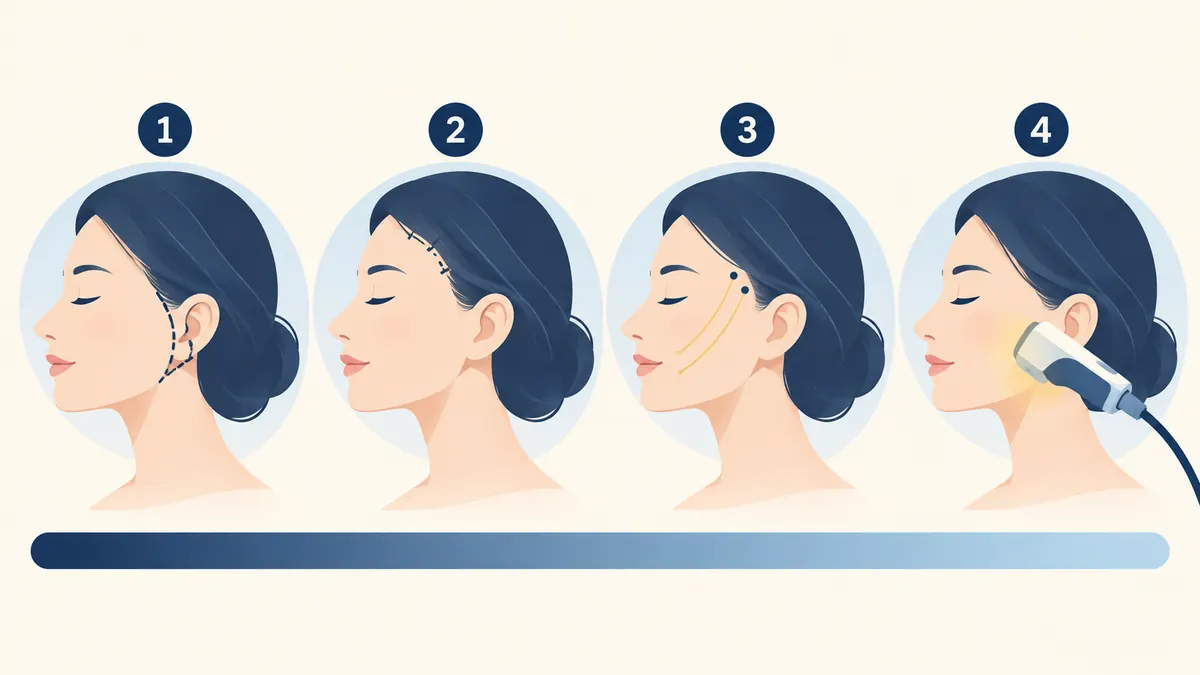
- Facelift. An incision in front of and behind the ear; the deeper tissue and skin are lifted.
- Endoscopic brow lift. Three to five short incisions hidden in the hairline; the brow is raised and often held with a small absorbable device such as Endotine.
- Thread lift. Barbed threads go in through small needle entry points and hold tissue up.
- Energy devices. Ultrasound, radiofrequency and similar devices work through the skin with no cut and no needle.
From left to right: more surgical to less. Schematic.
Surgery: one operation, the largest change
A full facelift (SMAS or deep plane) lifts the deeper tissue layer of the cheek, jaw and neck, not only the skin, through an incision that runs in front of the ear and behind it into the hairline. It takes about 2–3 hours, usually under general anaesthesia, and most patients stay one night. In a study that measured 50 patients 5.5 years after surgery, the jowl had been lifted about 6 mm and 76% still looked younger than before; the neck relaxes back more than the jawline.
A mini or short-scar lift treats the lower face through a shorter incision, most often under local anaesthesia or sedation. An endoscopic brow lift raises a heavy brow through three to five short incisions hidden behind the hairline; the lifted tissue is often held while it heals by a small absorbable implant such as Endotine, anchored in a tiny hole in the skull and absorbed over about a year. A meta-analysis found the brow raised by about 3–4 mm at a year or more, and the result usually lasts about 5–6 years: one series followed Endotine brow lifts for three to almost seven years, and a study of endoscopic brow lifts found the lift still present at 5.4 years.
Serious problems are uncommon. Recent reviews of more than 10,000 patients each put bleeding under the skin (haematoma) at about 2–3%, temporary weakness of a facial nerve at about 1%, and permanent nerve injury under 0.1%. Stitches come out after about 5–10 days, bruising lasts at least two weeks, and most people need 2–3 weeks before they feel presentable. Plan about 7–10 days in Seoul. See Facelift.
Threads: small entry points, a shorter lift
A thread lift places dissolvable barbed threads under the skin through small needle entry points, under local anaesthetic, to hold the cheeks and jawline up. There is no incision to stitch, and most swelling settles within days.
The lift is real but does not last like surgery. A meta-analysis of 26 studies found swelling in 35% of patients and small dimples in 10%, with satisfaction falling from 98% just after treatment to 88% at six months. Slower-dissolving threads (PCL or PLLA) are quoted to last up to about two years, and the longest follow-up in a 2024 review of absorbable threads is two years; an older independent review found the effect shorter in most studies. Threads suit a modest change that should last a year or two, rather than a permanent fix. See Thread lift.
Microneedle radiofrequency (such as Morpheus8 or Potenza) also belongs in this middle group, since its needles enter the skin. It tightens and refines texture rather than lifting, and the US regulator issued a safety warning in 2025 about burns and scarring, so choose an experienced doctor.
No cut, no needle: energy devices
Focused ultrasound (Ultherapy and the Korean Shurink) delivers heat to tiny points at set depths, down to the SMAS layer that surgeons lift in a facelift. Ultherapy is one of only two devices the US regulator has cleared specifically to lift, and only for the brow and the area under the chin and neck. In studies the brow rose about 0.5–1.7 mm, with improvement lasting at least a year. Sofwave works on a similar principle at a shallower depth and carries the same lift clearance.
Radiofrequency devices (Thermage and the Korean Density, Oligio and Volnewmer) heat a broader zone of the deep skin. Thermage is cleared for wrinkles rather than lift; in one trial 61.5% of brows rose at least 0.5 mm, and a Korean study of Volnewmer measured about 1.5–2 mm. Onda uses microwaves and is designed mainly for fat reduction and contour, and Titanium is a diode laser originally made for hair removal that Korean clinics use for skin quality and tightening.
These devices need no anaesthetic beyond a numbing cream, leave little or no visible downtime, and fit a short trip. The trade-off is size and repetition: where it has been measured, the change is a few millimetres at most, and results are kept up with repeat sessions, usually every year or so for ultrasound and radiofrequency, and as a series for Titanium. See Ulthera, Thermage and Rejuran vs Ulthera vs Thermage vs Juvelook.
2026: why Korea is moving to the no-cut end
Korean patients are choosing the least invasive option more and more. On Babitalk, a Korean cosmetic booking app, lifting made up 27% of procedure searches in early 2026, ahead of filler and Botox, and Ultherapy was the most searched procedure in every age group. Business press reports that the main lifting-device makers grew revenue by more than 45% a year over three years, and describes lifting as routine upkeep rather than a one-off event.
Our own count of a Korean community's price entries points the same way: thread lifts and mini lifts fell, while Ulthera, Thermage, Onda, Titanium and Density rose. See Korean plastic surgery trends in 2026.
The appeal is easy to see: no scar, no hospital stay and no time off work. What it asks in return is regular visits, because each session adds a smaller change. This is a Korean shift rather than a global one: worldwide, non-surgical skin tightening grew 38.9% in 2024, but facelifts also grew, by 7.4%.
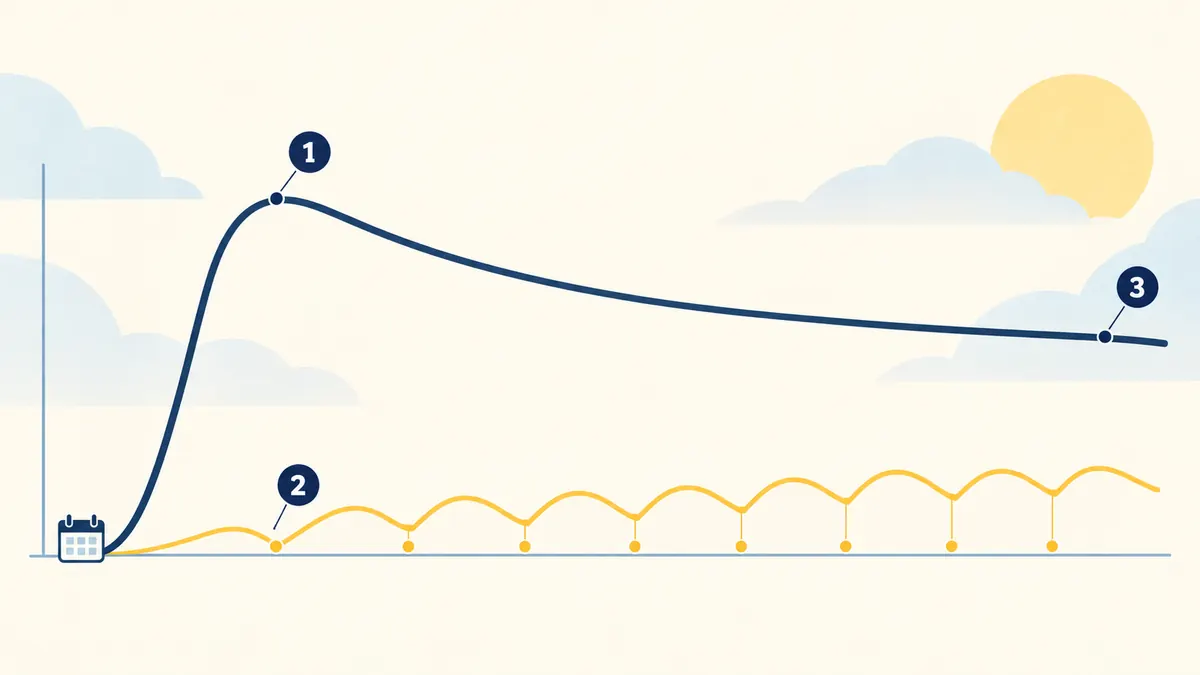
- Surgery. One operation and one large change, which settles slowly over years.
- Device sessions. Each session adds a smaller change, and repeat visits keep it up.
- Years later. Surgery keeps more of its effect; the device route depends on keeping up the visits.
Schematic, not data. How much and how long varies from person to person.
Lifting, or firming? What each treatment actually does
Only some "lifting" treatments move tissue upward. Many mainly make the skin firmer, smoother or fuller, and any lift is a side effect measured in millimetres or not at all. The table sorts them.
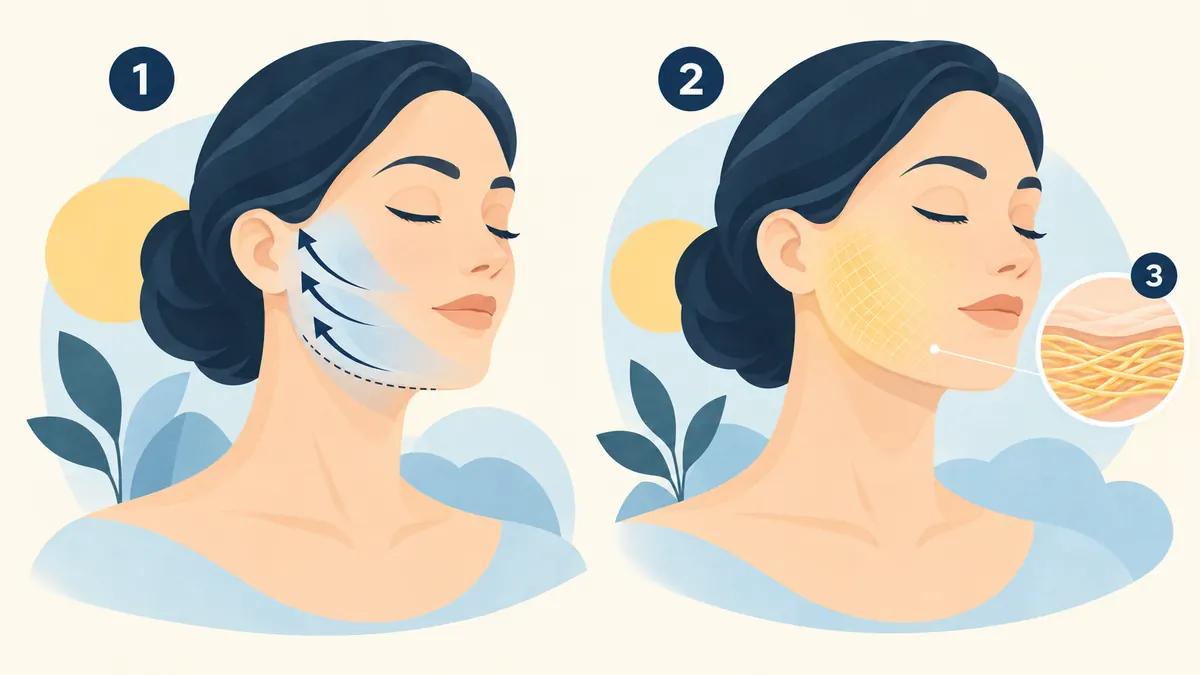
- Lifting. Tissue is moved up and back to a new position. Surgery does this; threads do it for a while.
- Firming. The skin and the layer beneath tighten where they are; any lift is a few millimetres at most.
- Collagen. Devices and collagen stimulators work by prompting new collagen, which builds over weeks to months.
Schematic.
| Treatment | Mainly does | Lift | Cut or needle | How often |
|---|---|---|---|---|
| Full facelift | Repositions deeper tissue and skin | Large: jowl about 6 mm | Incision | Once |
| Endoscopic brow lift (often with Endotine) | Raises the brow | Moderate: about 3–4 mm | Short scalp incisions | Once; lasts about 5–6 years |
| Thread lift | Holds tissue up with barbed threads | Modest, up to about 2 years | Needle entry points | Every 1–2 years |
| Ultherapy, Shurink, Sofwave (ultrasound) | Tightens; cleared to lift the brow and under the chin | Small: brow about 0.5–1.7 mm | None | About every 1–2 years |
| Thermage, Density, Oligio, Volnewmer (radiofrequency) | Firms skin, softens wrinkles | Small: about 0.5–2 mm where measured | None | Often yearly |
| Onda (microwave) | Reduces fat, shapes contour | Not a lift | None | As advised |
| Titanium (diode laser) | Skin quality and tightening | Not measured | None | A series, then top-ups |
| Microneedle RF (Morpheus8, Potenza) | Tightens, refines texture | Not measured | Needles | A series |
| Botox | Relaxes muscles; brow and jawline definition | Small and temporary: brow about 1.5 mm | Needle | Every few months |
| Filler placed for support | Volume that props up tissue | Indirect | Needle | Lasts months, then repeated |
| Sculptra, Juvelook (collagen stimulators) | Volume and skin quality over weeks | Not measured | Needle | A series |
| Rejuran, hyaluronic boosters | Skin quality, hydration, texture | Not measured | Needle | A course |
If you want the jawline or neck to sit visibly higher, only surgery reliably does that. If you want firmer, fresher skin with no downtime, devices and injectables fit, and a slight lift is a bonus.
Can you come back to Seoul regularly?
No-cut lifting keeps its effect through repeat sessions, so for a visitor from Indonesia the first question is not which device is best but how often you can return. Settle this before you book; it changes what makes sense.
- Back every 6–12 months: device lifting fits well. Plan a session on each trip, and add a booster or collagen-stimulator course if your skin needs it.
- Back once every year or two: choose what holds between trips: Ulthera or Thermage, usually repeated about yearly, or slower-dissolving threads, which can last up to about two years.
- A one-off trip: if you want a visible lift and are unlikely to return, a longer-lasting route such as surgery or a brow lift (about 5–6 years) may serve you better than a device that needs upkeep. If you prefer a device anyway, ask whether a clinic near home offers the same one for top-ups.
Tell us how often you can realistically travel. We check with the clinic which options still work at that rhythm before you commit.
Planning it into a trip from Indonesia
- Surgery: one trip of about 7–10 days, so the stitches come out and the surgeon checks you before the flight. See Flying home after treatment and Where to stay for recovery.
- Threads: a few days, so swelling can settle and the clinic can check you.
- Devices: no recovery stay is usually needed, and flying the next day is generally fine, so they fit a short trip. Ask how often the clinic suggests repeating it and plan the next session into a return visit.
- Clinic, not a spa: in Korea, medical lifting devices may only be used in a medical clinic. Using them in a skincare shop is illegal.
- Check the stay against your visa in Entry rules and visas for Indonesian travellers.
Considering one of these? Tell us your dates and we will plan the clinic visits around them.
Sources
- Facelift
- Facelift
- Facelift: a 5.5-year objective assessment (Jones & Lo, Plast Reconstr Surg 2012)
- Complications of deep plane facelift: systematic review and meta-analysis (2026)
- Haematoma after deep plane facelift: meta-analysis (2025)
- Facial nerve injury after facelift: systematic review (2025)
- Short-scar facelift: systematic review (Amador et al., 2024)
- A plastic surgeon's guide to brow lift recovery
- Endoscopic brow lift elevation: meta-analysis (Şibar et al., 2025)
- Endoscopic brow lift: a 5.4-year objective assessment (Jones & Lo, 2013)
- Bioabsorbable fixation device enables minimally invasive browpexy
- Thread lift complications and satisfaction: meta-analysis (Niu et al., 2021)
- Thread-lift sutures: still in the lift? A systematic review (Gülbitti et al., 2018)
- Update on absorbable facial thread lifts (systematic review, 2024)
- Longevity of brow elevation in endoscopic brow lift with Endotine fixation (ASPS 2016 abstract)
- Potential risks of certain uses of RF microneedling (safety communication, 15 Oct 2025)
- Ultherapy 510(k) K180623
- Micro-focused ultrasound for the face: systematic review (Contini et al., 2023)
- Sofwave FDA clearance for eyebrow, submental and neck lift (16 Nov 2021)
- Thermage FLX 510(k) K170758
- Thermage
- Monopolar radiofrequency, periorbital: multicentre study (Fitzpatrick et al., 2003)
- Monopolar RF lifting measured by 3D scan (Kim, 2024)
- Onda Coolwaves
- Soprano Titanium 510(k) K222064
- Botox Cosmetic approved for platysma bands (Oct 2024)
- Sculptra approved for cheek wrinkles (26 Apr 2023)
- 리프팅, 필러·보톡스 제치고 검색 1위 (Babitalk Q1 2026 data)
- 리프팅 시장 주요 기업 매출 증가 (12 May 2025)
- ISAPS Global Survey 2024
- 피부관리실 의료기기 사용 실태 (2026)
This guide summarises published guidance so you can plan and ask better questions. It is not medical advice. Your doctor assesses you in person and makes every treatment decision, including when you are fit to fly.
All treatment guides